![brand logo [Modern Japan Crafts]](https://static.wixstatic.com/media/23358e_0f315eac8cb04678817e234f06c3c1d9~mv2.png/v1/fill/w_49,h_49,al_c,q_85,usm_0.66_1.00_0.01,enc_avif,quality_auto/%E3%83%AD%E3%82%B4%20(2).png)
Is a Nambu Tetsubin Really Suitable for Daily Use? A Selection Guide Comparing Weight, Water Quality, and Maintenance
- Tai

- Nov 26, 2025
- 3 min read
Updated: Nov 29, 2025
Intro
Nambu tetsubin—traditional cast-iron kettles from Iwate—carry a mixed reputation. They are often described as heavy and prone to rust, yet also praised for producing soft, rounded hot water. This article evaluates whether they are practical for everyday use by comparing three clear criteria: weight, water taste, and maintenance requirements.
1. Context: Why Nambu Cast Iron Remains Significant
Originating from Morioka and Ōshū in Iwate, Nambu ironware developed as a functional tool in a cold-climate region where heat retention mattered. Cast iron stores thermal energy efficiently, allowing water to boil steadily over low fuel consumption. Over time, the interior of a tetsubin naturally accumulates a mineral layer called yuaka, which interacts with the local water composition and stabilizes flavor.
In other words, Nambu tetsubin were shaped not as ornamental teaware but as durable, climate-adapted household tools.
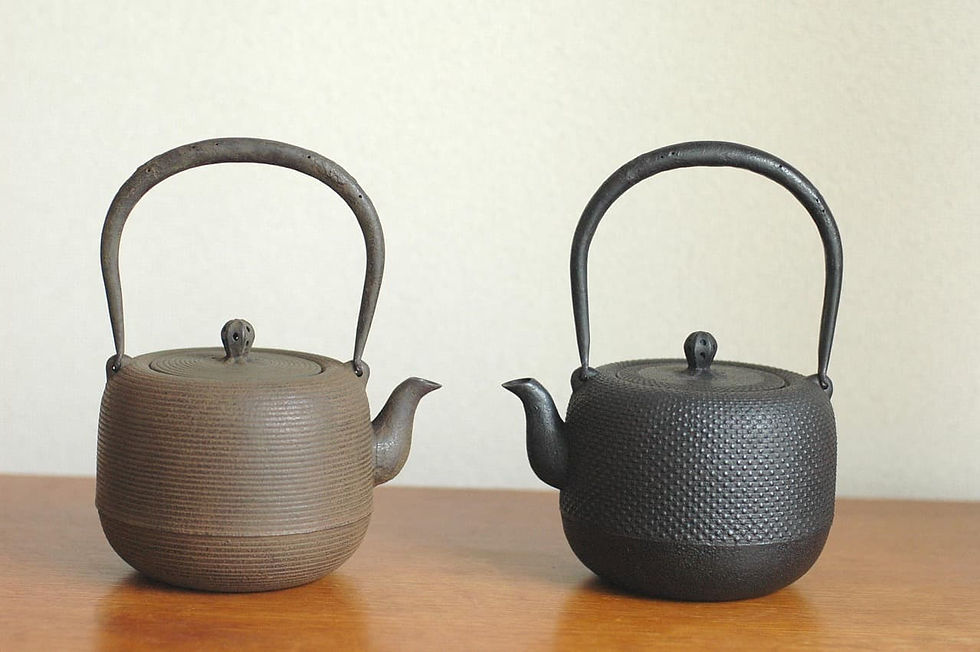
2. Evaluation Framework: Weight, Water Quality, Maintenance
These three criteria help determine whether a tetsubin aligns with daily routines.
① Weight: Mainly Determined by Capacity
0.6–0.8 L: Typically 600–900 g; suitable for morning coffee or tea.
1.0–1.2 L: Around 1.2–1.8 kg; a balanced “everyday” size.
1.5 L and above: Often over 2 kg; ideal for long-duration heating or winter use.
A tetsubin’s mass is tied more to its volume than to wall thickness. Newer small-batch productions often adjust handle angle and center of gravity to improve daily usability.
② Water Taste: Influenced by Interior Finish and Yuaka Development
Hot water from a raw-iron tetsubin may start with slight metallic notes during the first uses. As yuaka develops over weeks, the flavor becomes smoother and more stable.
Newly purchased: Flavors can vary depending on water hardness.
1–3 months of use: Yuaka stabilizes and reduces metallic taste.
Enameled “iron teapots”: Do not alter water flavor; they do not release iron ions.
Regions with soft water tend to show more noticeable changes in mouthfeel when switching between steel kettles and raw-iron tetsubin.
③ Maintenance: Less About Rust Risk, More About Drying Habits
Most rust issues arise from three situations: exterior water droplets, incomplete interior drying, and overdrying/empty heating.
Baseline care is simple but must be consistent:
Avoid washing the interior; leave yuaka intact.
After boiling, keep the lid off and let leftover heat dry the inside.
Wipe exterior moisture immediately.
Allow full air-drying between uses.
If these steps fit naturally into one’s routine, a tetsubin becomes a predictable tool rather than a demanding one.
3. Authenticity and Quality Assessment: What to Look For
Beyond price or brand names, three elements help distinguish high-quality tetsubin from mass-produced versions.
① Surface Texture (Casting Skin)
Fine, even texture indicates precise sand-mold casting and consistent heat behavior. Coarse, irregular surfaces may reflect simplified finishing processes.
② Spout Geometry
A clean, narrow spout with minimal internal steps gives better water control and reduces drips. Poor water cutoff often results from insufficient trimming of casting residue.
③ Lid Fit (Aiguchi)
The lid should sit evenly with no pronounced gaps or tight spots. Uneven fit can cause excessive steam loss or potential sticking as the kettle dries.
Because these details are hard to judge online, makers who publish clear process photos and explain finishing steps offer more reliable transparency.
4. Daily Use: More About Rhythm Than Weight
Whether a Nambu tetsubin becomes a comfortable daily tool depends less on its heaviness and more on how it matches a user’s pace.
Morning single-cup routines
→ 0.6–0.8 L tetsubin is easiest to handle.
Maintaining warm water during winter
→ Medium to large kettles benefit from greater heat retention.
Using IH cooktops
→ Requires a flat-bottom model; older kettles may not be compatible.
A tetsubin changes slightly through early use—water flavor stabilizes, the lacquered exterior settles, and handling becomes more intuitive. Evaluating it through “habit fit” rather than short-term convenience leads to a clearer assessment of practicality.
5. Closing Insight
A Nambu tetsubin suits daily life when its capacity, handling rhythm, and drying habits align with the user’s routine. Evaluating through weight, water taste, and maintenance provides a grounded framework, while craftsmanship cues—surface texture, spout accuracy, and lid fit—help identify reliable pieces. With these criteria, the tetsubin becomes a long-term household tool rather than a specialty item.
References
Nambu Tekki Cooperative Association – https://nambu-tekki.jp/
City of Morioka: Traditional Crafts of Iwate – https://www.city.morioka.iwate.jp/
Japan Institute of Metals: Fundamentals of Cast Iron – https://www.jim.or.jp/
Tohoku Kōgei Shimbun (Nambu Ironware Features) – https://tohoku-kogei.jp/


Comments